
40% of small businesses plan to increase hiring in the next 12 months. Most of them will wait until January to start preparing, post a role in February, and fill it in April or May. The businesses that fill Q1 roles in January are the ones that build the infrastructure in November and December. This playbook gives you a month-by-month plan for exactly what to build between now and your first Q1 hire so you’re posting from a position of clarity, not scrambling from a position of urgency.
Why This Playbook Exists
I want to be upfront about why we wrote this and who it’s for.
If you’ve been in the hiring pause for the last several months, telling yourself you’ll figure it out in Q1, January is closer than it feels. And the difference between the businesses that fill roles in January and the businesses that fill them in April comes down entirely to what they built before the year turned.
We’ve placed over 4,000 people into small businesses. The pattern is consistent: the owners who prepare during the pause fill roles in two to three weeks once they’re ready to move. The owners who wait until they’re ready to move and then start preparing take two to three months. Same talent pool. Same market. Completely different timeline based entirely on preparation.
This playbook is the preparation. Three months. Specific actions. A clear timeline. If you follow it, you’ll be posting from a position of clarity on January 2nd while your competitors are still sitting down to figure out what they need.
Key Takeaways
- The businesses that fill Q1 roles fastest are the ones that did the preparation work in Q4. Posting the role is the last step, not the first.
- November is for defining the role and writing the description. December is for building the onboarding and the pipeline. January is for posting, interviewing, and hiring.
- Each month has specific, actionable tasks that take a few hours total. This isn’t a massive project. It’s a disciplined sequence of small builds.
- The Invisible Audition is happening whether you’re ready or not. Every touchpoint a candidate encounters before they apply is being evaluated. This playbook makes sure you pass.
- By January 2nd, you should have the role defined, the description written, the onboarding planned, the pipeline warming, and the process mapped. That’s the starting line, not the finish line.
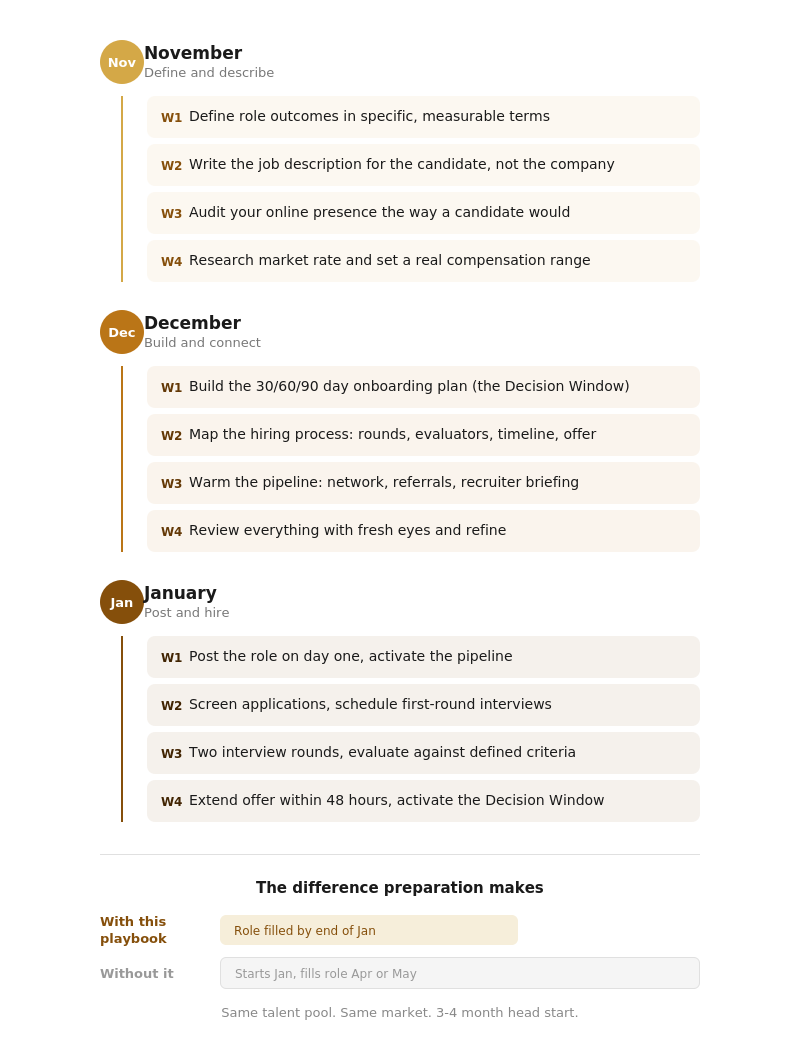
The businesses that fill Q1 roles in January are the ones that built the infrastructure in November and December.
November: Define the Role and Write the Description
November is strategy month. No posting. No sourcing. Just getting crystal clear about what you actually need so everything that follows is built on a solid foundation.
Week 1: Define what the role actually needs.
Sit down for one hour and answer these questions in writing:
What specific outcomes is this person responsible for? Not job duties. Outcomes. What does the business look like in six months if this hire is successful versus if you never made it?
What three to five skills are genuinely non-negotiable on day one? Not the 15-item wish list. The three to five things they absolutely must walk in with because you can’t train them in the first 90 days.
What does a typical week look like in this role? Not the abstract responsibilities. The actual Tuesday afternoon. What are they doing? Who are they interacting with? What decisions are they making?
What’s the growth path? Where does this person go in 12 months if they’re excellent? You need to be able to answer this before you post because the candidates you want are going to ask.
The owners who struggle most with hiring consistently skip this step. They go straight from “I need someone” to a job posting without ever getting specific about what the role actually requires. The description ends up vague because the thinking was vague. The candidates who apply don’t match because the filter was never defined. The hire takes three months because the first month was wasted on applications from people who were never right for a role that was never clearly described.
Week 2: Write the job description.
Take everything from Week 1 and turn it into a description that’s written for the candidate, not for the company. Lead with why someone would want this role at this specific business. Include a real compensation range. Describe the actual day-to-day work in specific enough terms that the right person reads it and thinks “that’s exactly what I want to do.”
We wrote a full guide on how to do this: How to Write a Job Description That Actually Attracts the Right People. If you follow that guide, the description you produce will outperform what 90% of small businesses post.
Don’t post it yet. Just write it. Set it aside. You’ll come back to it in January with fresh eyes.
Week 3: Audit your online presence.
Google your business the way a candidate would. Look at your website, your reviews, your social media, your Glassdoor profile if you have one. Ask yourself honestly: if you were a talented person evaluating whether to apply here, would what you find give you confidence?
We call this the Invisible Audition. Before any candidate applies, they’ve already evaluated your business based on what they can see online. Your description might be excellent but if the rest of the signal is inconsistent, the best candidates will keep scrolling.
Spend one to two hours cleaning up the most visible touchpoints. Update the team page on your website. Respond to any reviews that are sitting unanswered. Post something recent on your social media that shows the business is active and alive. None of this has to be perfect. It has to be present.
Week 4: Set the compensation.
Research what the market rate is for this role right now. Not what you paid the last person. Not what feels comfortable. What the market is actually paying for the skills you’re asking for in your geography.
Check salary surveys, job board data, and what competitors are listing. Talk to your recruiter if you have one. Get to a range you’re genuinely willing to pay, then put that range in the description you wrote in Week 2.
If the market rate is higher than you budgeted, that’s better to know now than in January when you’re wondering why nobody is applying.
December: Build the Onboarding and Start the Pipeline
December is build month. The role is defined. The description is written. Now you build everything the new hire will walk into on day one and start warming the pipeline so you’re not sourcing from zero in January.
Week 1: Build the 30/60/90 day onboarding plan.
We call the first 90 days the Decision Window because that’s when your new hire decides whether they made the right call. Organizations with strong onboarding improve retention by 82%. Only 12% of employees say their company does this well.
Build the framework now while there’s no pressure. Define what success looks like at 30, 60, and 90 days. Schedule the check-in cadence: week two, day 30, day 60, day 90. Identify who owns the onboarding process. Document the training the new hire will need in their first week.
We wrote a full framework on this: How to Onboard a New Employee at a Small Business (The First 90 Days). Follow that guide and your new hire walks into a structure that’s ready for them instead of one you’re building on the fly.
Week 2: Map the hiring process.
Before you post the role, know exactly what happens between “application received” and “offer extended.” How many interview rounds? Two is almost always enough for a small business. Who is involved in each round? What are you evaluating at each stage? What does your offer look like? How fast can you move from final interview to written offer?
Map this out in writing. The businesses that fill roles fastest have a process that’s defined before the first application arrives. The businesses that take months are designing the process while candidates are waiting.
If your process takes six weeks from application to offer, you’ve already lost the best candidates to businesses that move in two. Design for speed without sacrificing quality. Two interview rounds, a clear evaluation rubric, and a decision-maker who can move within 48 hours of the final interview.
Week 3: Start warming the pipeline.
You don’t have to be actively hiring to be building relationships with potential candidates.
Let your network know you’re planning to grow in Q1. Not a formal announcement. Conversations. “We’re looking to add someone in [role] in January. If you know anyone who might be interested, I’d love to hear about them.” Post on LinkedIn about what you’re building and where you’re headed. Talk to your recruiter about starting a passive search.
Ask your best employees who they’d recommend. Employee referrals consistently produce higher-quality candidates and faster time-to-hire than any other source. The person your best team member vouches for has already passed a filter no job board can replicate.
By January, you want warm leads in the pipeline, not a cold start from zero.
Week 4: Review and refine.
Pull up the job description you wrote in November. Read it with fresh eyes. Does it still accurately describe what the role needs? Is the compensation range still competitive based on what you’ve learned? Is the value proposition strong enough that you’d apply to this job if you were a candidate?
Review the onboarding plan. Review the process map. Make sure everything is ready so that when you hit January, the only thing left to do is post and start interviewing.
December is the month most owners waste. The holidays feel like a reason to push everything to January. But December is actually the highest-leverage month in the entire playbook because nobody else is using it. While your competitors are on autopilot waiting for the new year, you’re building the infrastructure that gives you a two-month head start. The owners who use December to build are the ones posting on January 2nd. The ones who wait until January to start are posting in February and hiring in April.
January: Post, Interview, and Hire
If you followed November and December, January is execution. Everything is built. You’re not scrambling. You’re activating.
Week 1: Post the role.
Post the description you wrote and refined. Put it on the two or three job boards that make sense for your role and your geography. Share it on LinkedIn with a personal note about what you’re looking for and why this role matters to the business. Activate the network connections you warmed up in December.
If you’re working with a recruiter, they should already have the description and the process map. Give them the green light and let them move.
Week 2: Screen and schedule.
Applications should be arriving by the middle of the first week if the description is specific and the compensation range is visible. Screen against the three to five non-negotiable requirements you defined in November. Don’t waste time on candidates who don’t meet those. Schedule first-round interviews for the end of week two.
Respond to every applicant within 48 hours, even the ones you’re passing on. How you treat candidates who don’t get the job shapes how the market sees your business. And in a small business community, reputation compounds.
Week 3: Interview and evaluate.
Two rounds. First round: fit, capability, alignment with the role as described. Second round: deeper dive, meet the team, practical assessment of how they think about the work. Use the evaluation criteria you defined in December’s process map so you’re comparing candidates against the role, not against each other.
Make notes after every interview. Specific observations, not gut feelings. “They described how they handled a process breakdown at their last company and the approach aligned with how we operate” is useful. “Good vibe” is not.
Week 4: Offer and onboard.
Move fast. The candidate you want is the candidate three other businesses want too. Get the offer out within 48 hours of the final interview. Make it clean, clear, and competitive. Include the compensation you already defined, the start date, and a brief description of what their first week will look like.
When they accept, activate the Decision Window framework you built in December. Send the welcome message within 24 hours. Share the first-week overview. Make sure their workspace, systems access, and equipment are ready before they walk in the door.
By the end of January, you have a new hire sitting in a role that was defined with intention, filled through a process that moved with speed, and onboarded into a structure that was built before they arrived.
Your competitors are just now writing their job description.
The Q1 Hiring Checklist
Print this. Check each one off as you go.
November
- Role outcomes defined in specific, measurable terms
- Three to five non-negotiable requirements identified
- Day-to-day work described in concrete detail
- Growth path for the role defined
- Job description written for the candidate, not the company
- Real compensation range included in the description
- Online presence audited and cleaned up
- Market rate researched and budget confirmed
December
- 30/60/90 day onboarding plan built
- Check-in cadence scheduled (week 2, day 30, day 60, day 90)
- Onboarding process owner named
- Hiring process mapped: rounds, evaluators, timeline, decision-maker
- Network notified about Q1 hiring plans
- Employee referrals requested
- Recruiter briefed (if applicable)
- Description and process reviewed with fresh eyes
January
- Role posted on day one
- Applications screened within 48 hours
- First-round interviews scheduled by end of week two
- Second-round interviews completed by end of week three
- Offer extended within 48 hours of final interview
- Welcome message sent within 24 hours of acceptance
- First-week overview shared before start date
- Workspace, systems, and equipment ready before day one
What Happens If You Don’t Prepare
This isn’t hypothetical. We watch it happen every January.
The owner who waited decides they’re ready to hire. They spend the first two weeks of January writing a job description from scratch. It goes live in late January. Applications trickle in through February because the description is vague and there’s no compensation range. The first interviews happen in early March. The offer goes out in late March. The person starts in April. The onboarding is improvised because nobody built it. By June, the owner is wondering why the hire isn’t performing and the new employee is wondering whether they made the right call.
That’s a five-month process for a role that could have been filled in three weeks if the infrastructure had been built in advance.
We covered the full cost of that delay in our piece on what turnover actually costs and in our piece on what happens to your business while you wait to hire. The math is clear: every month of delay costs your business in team overload, client impact, and your own time pulled back into operations.
What We See From the Other Side
Every January we have two kinds of conversations with business owners. The first kind: “Here’s the role, here’s the description, here’s the process, here’s the onboarding plan. We’re ready to go.” Those placements happen in two to three weeks. The second kind: “I need someone yesterday. I’m not sure exactly what the role looks like yet but I need help.” Those placements take two to three months, cost more in recruiter time, and produce weaker results because the urgency overrides the clarity.
The difference is never the market. The difference is never the talent pool. The difference is always preparation. The owners who built in Q4 hire in January. The owners who start in January hire in Q2. After thousands of placements, this pattern has never varied.
Your Q1 Hire Starts Today
January feels far away. It isn’t. If you’re planning to hire in Q1 and you haven’t started the preparation work, this week is the week to start.
Open a document. Write down what the role actually needs. Define the outcomes, the requirements, and the day-to-day. That one hour this week sets everything else in motion.
At Ciprani Consulting we help small business owners build the hiring infrastructure that makes Q1 hires land faster, perform better, and stay longer. If you want help defining the role, writing the description, building the onboarding, or mapping the process, let’s talk before the year turns.
Ready to build your Q1 hiring plan?
We help small business owners prepare for their next hire before they need to make it. 30 minutes with our team now saves you months in Q1.
Frequently Asked Questions
How far in advance should I prepare to hire?
Eight to twelve weeks before you want someone in the seat. If you’re targeting a January hire, the preparation work should start in November. That gives you time to define the role, write the description, build the onboarding, map the process, and warm the pipeline without the pressure of urgency driving every decision. The businesses that prepare this far in advance consistently hire faster, hire better, and retain longer than those that start when the need becomes urgent.
What should I do before posting a job?
Define the role outcomes in specific terms, identify three to five non-negotiable requirements, write a description that leads with what the candidate gets, include a real compensation range, audit your online presence, build a 30/60/90 day onboarding plan, and map your interview process from application to offer. All of that should be done before the posting goes live. A posting without that preparation behind it attracts the wrong people, moves too slowly, and produces hires that don’t stick.
How do I hire faster at a small business?
Speed comes from preparation, not shortcuts. Define the role before you post. Limit your interview process to two rounds. Know your offer before you start interviewing. Designate one decision-maker who can move within 48 hours of the final interview. Respond to every applicant within 48 hours. Top candidates are available for roughly 10 days before they accept another offer. Every day your process takes beyond what’s necessary is a day the best candidates are being hired by someone else.
What if I’m not sure I’ll be ready to hire in Q1?
Build anyway. The preparation work costs nothing but your time and every piece of it is useful whether you hire in January, March, or next September. The role definition, the description, the onboarding plan, the process map. None of it expires. And if you do decide to move in Q1, you’ll be ready in hours rather than weeks. The worst case scenario of preparing too early is that you have infrastructure sitting ready. The worst case of preparing too late is that you spend three months scrambling while your competitors fill the same roles in three weeks.
Should I use a recruiter for Q1 hiring?
It depends on the role and your capacity. For specialized or leadership positions, a recruiter can access candidates you can’t reach through job boards alone. For operational or entry-level roles, a strong job description on the right boards combined with employee referrals often produces equally strong results at lower cost. If you do use a recruiter, brief them in December so they can start sourcing before January. A recruiter who gets the brief on January 15th is two weeks behind one who got it on December 1st.
What’s the biggest mistake businesses make when hiring in Q1?
Waiting until January to start. The role definition, the description, the onboarding, the process design. All of that work takes time and thought. When it’s done under the pressure of urgency in January, every step is rushed. The description is vague because there wasn’t time to be specific. The process is slow because it’s being designed while candidates are waiting. The onboarding is improvised because nobody built it in advance. The businesses that avoid this do the work in Q4 while the pressure is low and the time is available.
How does Ciprani Consulting help with Q1 hiring?
We help small business owners build everything in this playbook before January. That means defining the role, writing the description, building the 30/60/90 day onboarding plan, mapping the hiring process, and sourcing the right candidates. Whether you want us to handle the entire process or you want to build it yourself with our coaching, the Strategy Sprint call is where we figure out which approach fits your situation and get the preparation started before the year turns.

